
We’re told the $9.99 price cap is for the reader’s benefit. But if that’s true, why are traditional publishers allowed to charge $14.99 and keep their 70% margins? The truth is, the 35% 'Success Tax' is a gatekeeping tool. Here is how Amazon tilts the playing field against Indie Authors—and how we’re tilting it back.
There is a hidden “ceiling” in digital publishing that most indie authors never question.
If you price your ebook at $9.99 on Amazon, you keep roughly $7.00. But the moment you try to signal “Premium”—the moment you move that price to $14.99 or $30.00 to reflect the years of research and world-building you’ve poured into your series—Amazon slashes your royalty from 70% to 35%. It happens if your file is larger than 50mb too!
They effectively tax your success.
On a $30.00 digital product, Amazon takes $19.50, leaving you with about $10.50. You are doing 100% of the world-building, but they are taking 65% of the reward just for hosting a file.
In the Sovereign Author model, we flip the script. By moving to a Digital Special Edition sold directly to your readers, that same $30.00 sale nets you about $28.50. One sale of a Digital Special Edition is worth nearly five sales of a standard retail ebook. And you get to keep the customer data.
But how do you actually structure a digital file so that a reader feels like $30 is a bargain? And what does the “Middle-Man Math” look like when you factor in Stripe fees, delivery costs, and the psychological “Value Gap”? The answer isn't in adding more words; it's in changing the Architecture of the reader’s experience. Below, I’m showing you the 'Artifact-to-Value' ratio and the exact file structure that turns a download into a trophy.
I'm an author, not a CPA. But I realized that if I didn't learn the 'Middle-Man Math,' I was essentially donating my world-building to a trillion-dollar company. Here is the simple logic I used to realize I was leaving $18 on the table with every sale... In this post, I’m breaking down the exact spreadsheet logic we use at Eris Digital Media to justify premium pricing, including:
-
The “Artifact-to-Value” Ratio: How many visual assets do you need per 10k words?
-
The delivery fee myth: Why selling a 50MB “Trophy File” is actually cheaper than selling a 5MB Kindle file.
-
The “Founding Author” Pricing Calculator: My internal tool for setting your direct-sales floor.
If you’ve read my other articles, then you know what Digital Special Editions are. And if you’ve read through The Archival Blueprint (use the contact form to get your copy), you have a framework for how to start the development process. But you are serious about doing this on your own, and I’m here to support you. If you're looking at your manuscript and wondering where your 'Museum Moments' should live, that's exactly what we'll be covering in a discovery call. We’ll find your anchors together. I want to start a revolution in digital ebooks, and I can’t do that on my own. So here are some nuts and bolts that might have overwhelmed casual readers of The Archival Blueprint.
But How Many Artifacts?
First up, let’s talk about how many images you’ll need for your book. That sounds like an easy one, but there is some nuance to it. Too few, and the reader wonders what was supposed to be so special about the book. On the other hand, you don’t want to overload your reader’s tablet and turn those 70,000 words into a picture book. You have to find a balance that is right for your work. I write romance, so I will often pick a particular scene and ‘illustrate’ that.
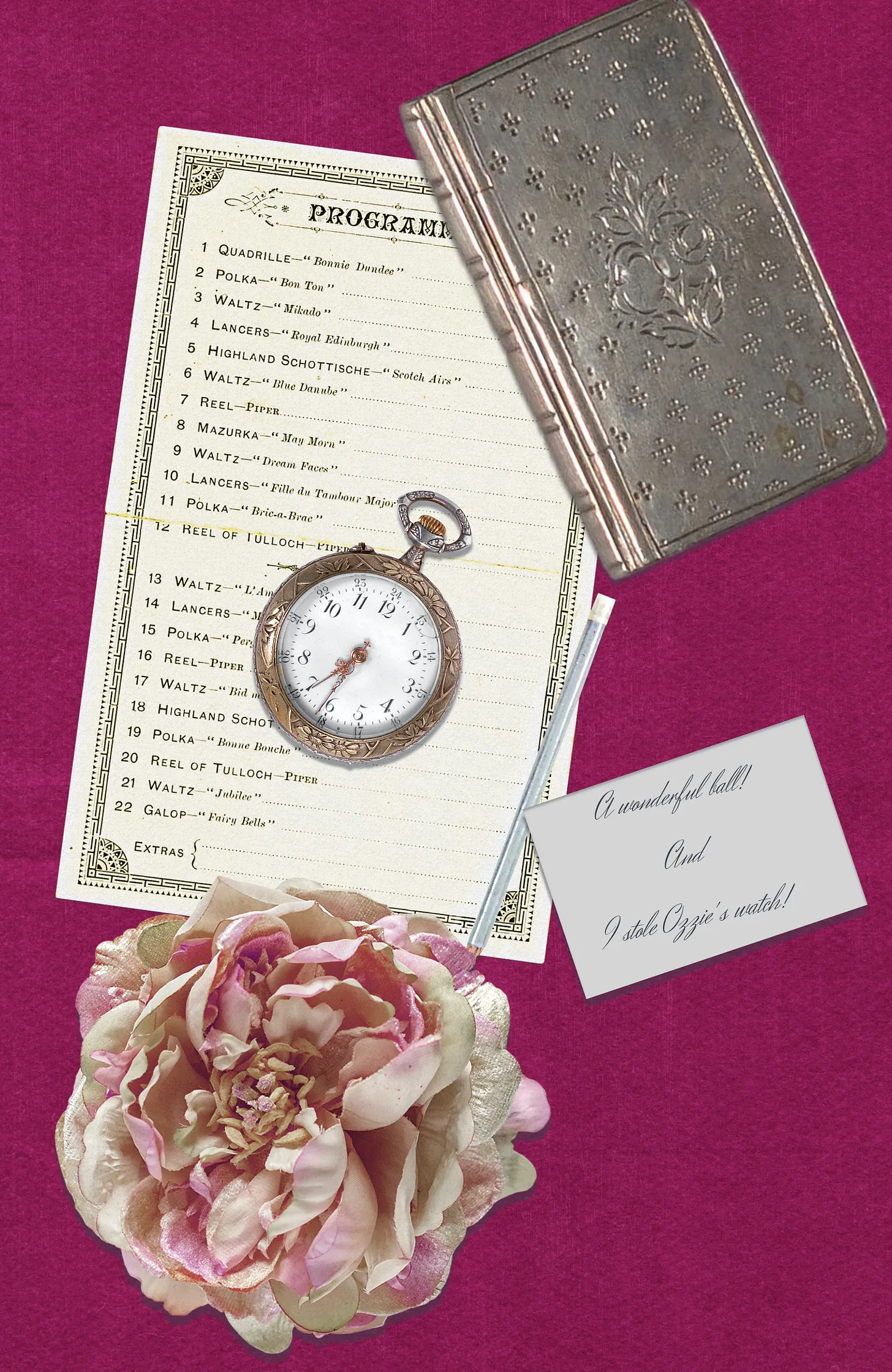
A little vocabulary, because every revolution has its own vocabulary. The pocket watch shown above is an artifact. The page it is part of is a collection and becomes a ‘Museum Moment’ for the reader. It shouldn’t be a stretch for the reader to imagine those items, in this case, on a bedspread after the ball, where she bonded with the hero over pranking her brother, his best friend. The hope is that the image reinforces the words on the page, not that it supplants them.
The reason we aim for 2 artifacts per 10k words isn’t just about cost—it’s about narrative rhythm. In an Archival Edition, the visual shouldn’t compete with the prose; it should punctuate it. We give the reader a ‘Museum Moment’ just as they are finishing a major emotional arc, or to set a feeling at the start of a story, they can then come back to and find the Easter eggs. This makes them a participant in the story, allowing them to linger in the world. The human mind lives to solve these kinds of problems.
Depending on the package an author chooses when they work with me, that kind of page above, and another one like it, may be the only visuals in the book. That is not to say there wouldn’t be a bonus novella, and maybe a podcast script with an audio link too. The whole point of these is to curate a better reader experience than they can get through any retailer, so they have to buy directly from the author.
A standard ebook is a disposable file stored on a corporate server. A Digital Special Edition is a digital trophy. By using this 2-per-10k ratio, you are ensuring that your work isn't just read—it’s collected. You are giving your readers something they will want to keep on their 'digital mantle' forever.
Artifact /Value Ratio
Metric Detail
Logic Pacing over Decoration
The Rule: 2 High-Fidelity Artifacts per 10,000 words
Example 70k-word novel = 14 artifacts assembled into 2 ‘Museum Moments’
Reader Value ~$2.14 per unique artifact in a $30 edition
Why don’t you want to overload your book with images?
Now, you might be thinking: ‘But if I put 14 high-fidelity artifacts into my book, won’t the file size be massive? Won’t Amazon’s delivery fees eat my entire profit?’
That is exactly what Amazon wants you to think. Let’s look at the ‘Middle-Man Math’ that the retailers don’t want you to see.
This is a catch-22 only Indie authors deal with. If Simon & Schuster puts a book, loaded with images, up on Amazon as an ebook for $17.99, they keep 70 percent of that sale. Period. It doesn’t matter how big the file size is, and they aren’t capped at $9.99. The price Amazon virtually forces Indie authors to cap at. But why?
Supposedly, that $9.99 cap was because it was what was best for the reader. So why doesn’t it apply to Trad pubbed books? Because supposedly, a Trad-pubbed book had a mark of quality that Indies could never have. Except, at least in the romance world that I’m most familiar with, most of the Trad-pubbed books out in the last year have come straight off of fan-fiction sites. The only changes being made are those that protect the publisher from being sued by, say, J.K. Rowling, because the writer wrote a love story with Draco and Hermione.
The Trad publishers still have enough sway that if they opted not to use Amazon, the ’zon would feel the pinch— The trad big five still release somewhere around 50,000 fiction titles a year, according to industry reports. Those are the ones that get the marketing dollars thrown at them.
Contrast that with what comes from Indie authors. Self-published books, tracked by ISBN, and many who publish straight to retailers don’t bother with ISBNs; the number published is 2.6 MILLION. So for every 1 Trad book published, 5 are Indie released. Starting to see why it is harder and harder to stand out on big retailers? Because while Amazon may be the 800lb. gorilla, the problem is everywhere.
And it is only getting worse. People are punching in the thinnest of plots into AI, slapping an AI cover on it, and calling it a book. I’m a writer. I know how hard it is to write, edit, make cover decisions, and then market a book that feels like you ripped a little piece of your soul out. Those AI books are counted in that 2.6 million because none of the retailers can really sort them out yet. And most readers just think it is a bad book, not that it was birthed by a machine. But we are talking about delivery fees, remember delivery fees?
The Delivery Fee Myth
Cost Type Amazon Direct Sales (Stripe/Shopify)
Standard File (5MB) ~$0.75 Delivery Fee $0.00 Delivery Fee
Large File (50MB) $7.50 Delivery Fee $0.00 Delivery Fee
Amazon (100MB)
(Transaction Fee forced to 35% Royalty Included in 30% cut ~2.9% + $0.30)
EDM File (100MB) $0.00 Delivery $0.00 Delivery Fee
Bottom Line: On the Retailers Quality is penalized. Selling Direct Quality is free.
That table lays out in cold column inches the clear difference of selling on Amazon vs. selling on your own website. If you want to charge more for an Digital Special Edition, Amazon wants its pound of flesh. If the file is slightly larger than what they currently sell, they only want their delivery fee. If you want to send readers a premium book with a file size up to 50MB that delivery fee will make your eyes water with real tears. But you’re still getting the 70% before they take those charges out— well, provided you still are selling it for $9.99. Wanna go crazy and have a visual spread with every chapter and embed audio files? That is going to push your file size up dramatically, along with knocking your royalty rate down to 35%, but hey, if Amazon is going to keep 65% of the sales price, they are willing to throw you a bone and not charge you a delivery fee on top of it.
They aren't just taking a cut of your money; they are taxing the very quality of your work.
Price makes a difference, but probably not how you think.
If you tell a casual reader you’re charging $30.00 for a digital book, they’ll look for the “Buy” button on Amazon and see a $9.99 ceiling. But you aren’t selling a “flat file.” You are selling a Trophy.
At Eris Digital Media, we use a three-step “Value Stack” to determine the floor for a Sovereign Author’s work:
Step Component Value Added Total
The Base (Standard Ebook) The market standard for the ‘words’ $9.99
Architecture Archival Blueprint 40+ hours of curation, artifacts +$15.00
Access Buying Direct Direct-only exclusives +$5.00
The Floor The Archival Digital Edition A collectible digital artifact $29.99
This is where most authors undersell themselves. You aren’t just a writer; you are the creator of a reader experience. The time it takes to source a high-resolution 19th-century pocket watch, decode the historical accuracy, and engineer it into a “Museum Moment” is a specialized skill. In the traditional world, a team of designers would do this, and the book would be a $50 coffee-table hardback. My goal, and yours if you are DIYing this, is to bring that level of quality to the digital space.
The Access Premium ($5.00)
When a reader buys directly from you, they are entering your “inner circle.” This $5.00 represents the “Sovereignty Tax”—it covers the extras that Amazon literally cannot host, like high-fidelity audio commentary or a hidden “backstage” link to your research vault. It should also bring them some access to you. I worked in Customer Service, big spenders, get perks. So yes, you are going to make an email list just for them, and you are going to let them know when you have a new Archival Digital Edition coming out with exclusive content just for them. Ideally, you’ll treat all of your readers like they are crucial to your business, but in the case of someone buying a book where you recoup $27.75 with no delivery costs, you better believe I’m treating them like gold.
The “Founding Author” Math
For those of you looking to launch your first Sovereign project, $30.00 isn’t just a number I pulled out of a hat. It is the minimum required to:
- Cover your transaction fees (which are pennies on your own site).
- Value your labor as an architect, not just a formatter.
- Signal Quality. If you price it at $9.99, the reader assumes it’s a commodity. If you price at $30.00, they know they are entering an experience. Think of it like the difference between going to the local playground and a trip to a Disney park. You will enjoy both, but the trip to Disney is going to be remembered. That is the difference you are looking for. The file they download from a retailer is a trip to the local playground—functional and familiar. The Archival Digital Edition you deliver is the Disney experience: every sight, sound, and 'Museum Moment' has been engineered for wonder. You aren't just selling them a story; you’re selling them the memory of the story.
For those of you looking at adding a digital tier with the possibility of making money on your physical special edition campaign, this math is even more important without the headaches of fulfillment. Push a button to send your backers their books, and hang onto those dollars to cover your overhead.
The Homework: Audit Your “Museum Moments”
Before we get on our first coaching call, I want you to look at your current manuscript (or the one you’re planning) through the lens of a Digital Architect.
Find the “Emotional Anchor”: Identify one scene in your book where the reader’s pulse should be at its peak. What physical object is in that room? A letter? A locket? A blood-stained map?
- Artifact Extraction: If you were to pull that object out of the story and place it on a reader’s desk, what would it look like? This is your first Artifact.
- The “Museum Moment” Sketch: Imagine a single high-fidelity page that captures the feeling of that chapter. If you are a romance author, what three items together would “decode” the chemistry of that scene?
- The Math Check: Take your total word count and divide by 10,000. If you have a 70k-word book, do you have 14 Artifacts that could be assembled into 2-3 Museum Moments that justify a $30.00 price tag?
Don’t worry about the “How” yet. Just find the “What.” Mind the chapter in The Archival Blueprint [Sourcing Visual DNA] (p. 10) that talks about the difference between Creative Commons and Commercial Licensing.